

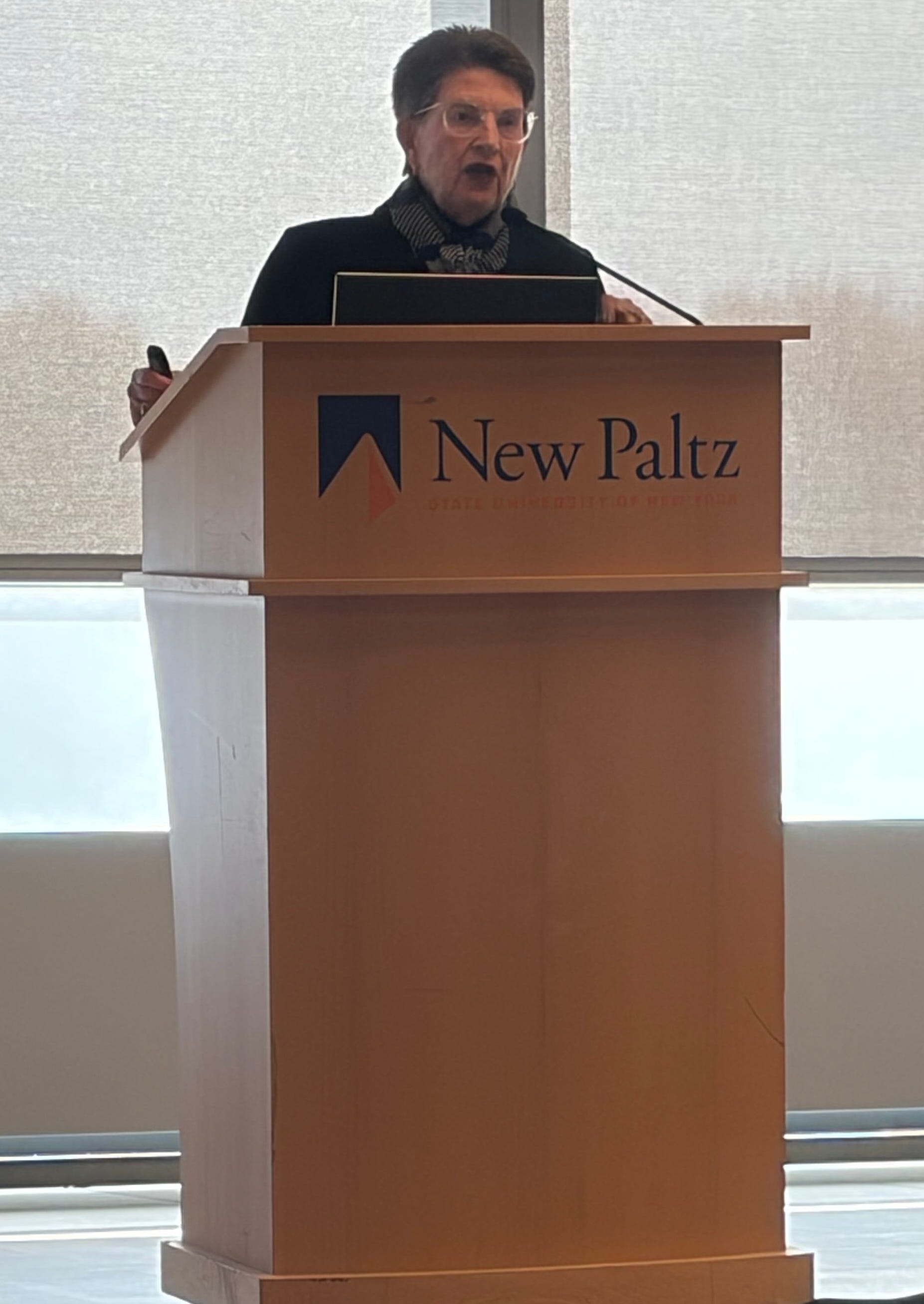
On a beautiful Saturday in the Hudson Valley, I had the pleasure of speaking to approximately 150 people at the Hudson Valley Estate Planning Council’s Estate Planning Day, held at SUNY New Paltz in New York.
What a wonderful experience.
The speakers were excellent, the audience was attentive and engaged, and the conversations reminded me once again why I am so passionate about helping people rethink retirement.
The day’s program covered the essential elements of estate planning: wills, trusts, healthcare directives, Social Security benefits, and charitable giving. These are enormously important topics. We need to protect what we have accumulated, prepare for our families, and make thoughtful decisions about the future.
But I was there to introduce another dimension of planning.
We spend years preparing for what happens to our assets when we are gone. How much time do we spend preparing for the life we are still going to live?
That was the heart of my presentation, Rethink Retirement: It’s not the end but the beginning of what’s next.
And the conversations that followed were fascinating.
Three Days a Week. A Lifetime in the Air Force. Two Very Different Transitions.
Several people I spoke with were quite proud of how they were approaching retirement.
They weren’t stopping work abruptly. Instead, they were transitioning into semi-retirement, going into the office three days a week rather than five.
They seemed pleased with their arrangements. They had found a way to maintain their professional identity, stay connected to colleagues, and preserve some of the structure that had shaped their lives for decades.
I found myself wondering: What happens when those three days become two? Or one? Or none? They seemed happy and that was all that mattered—for the moment.
Perhaps they will have already created new interests, relationships, and activities that make their days meaningful. Perhaps they will discover that they want to keep working in some capacity indefinitely.
There is no reason to assume that retirement must mean stopping work altogether.
Then I met a gentleman who was retiring after a lifetime in the Air Force.
His experience was quite different.
He was anxious. Concerned. Unsure about what he would do next.
Think about what a military career provides beyond employment. A mission. A clearly defined role. A community. A sense of belonging. Structure. Responsibility. A powerful identity.
And then, one day, that career ends.
What replaces all of those things?
I couldn’t help thinking about how different his transition might be from that of someone gradually reducing their hours in an office. Yet beneath those differences, both are confronting the same fundamental question:
Who am I going to be when I am no longer doing what I have always done?
Retirement Is More Than a Financial Event. It Is a Cultural Transition.
As a corporate anthropologist, I have spent my career observing how people navigate change.
What fascinates me about retirement is that we have created an elaborate system for helping people prepare financially, but remarkably few shared practices for helping them prepare socially, emotionally, or personally.
We celebrate retirement with parties, speeches, gifts, and congratulations.
And then?
Monday morning arrives.
There are no meetings on the calendar. No colleagues waiting for decisions. No students to teach, patients to care for, employees to lead, or missions to accomplish.
For some, this freedom is exhilarating.
For others, it is unsettling.
And for many, it is both.
Anthropologists have long studied rites of passage. We know that major life transitions often involve three stages: leaving an old role, navigating an uncertain in-between period, and entering a new identity.
Our culture is pretty good at celebrating the departure.
We are far less effective at helping people arrive somewhere new.
Perhaps that is why so many people who have successfully navigated complicated careers find retirement surprisingly difficult.
They know how to accomplish things. They just haven’t yet figured out what they want to accomplish next.
Four Questions We Need to Ask Ourselves
In my research and in the conversations surrounding my book, Rethink Retirement, I keep returning to four essential pillars of a meaningful next chapter.
Identity: Who am I now?
For decades, our work often provides the answer. We are executives, teachers, physicians, entrepreneurs, military officers, or professionals.
But those are roles we play. They are not the entirety of who we are.
What other parts of ourselves are waiting to be discovered or rediscovered?
Structure: How will I organize my days?
We often dream about escaping our schedules.
Then we discover that having no schedule can feel surprisingly uncomfortable.
What would a wonderful ordinary Tuesday look like? Not a vacation day. Not a special occasion. Just a Tuesday you would be happy to live again.
Purpose: Why does tomorrow matter?
Purpose doesn’t have to mean starting another business, joining a board, or changing the world.
It might mean mentoring someone, helping a grandchild, learning something new, volunteering, creating, or simply becoming more engaged in your community.
Purpose means having a reason to care about tomorrow.
Community: Who are my people?
Work often provides relationships we take for granted.
When we leave, those relationships can change. The casual conversations, shared challenges, friendships, and sense of belonging may no longer be part of everyday life.
Who will we spend time with? Who will notice if we don’t show up? Where will we feel that we belong?
These aren’t questions that can be answered with a retirement calculator.
But they deserve just as much attention as our financial projections.
What I Am Learning From You
One of the unexpected pleasures of writing Rethink Retirement and speaking with people about it is how much I continue to learn.
Every conversation adds another dimension to my understanding.
Some people cannot wait to retire. Others are frightened of losing the identity they have worked so hard to build.
Some are discovering that semi-retirement offers a wonderful bridge between their old lives and their next chapters.
Others have already retired and are realizing that the life they imagined isn’t quite the life they are living.
And still others have found extraordinary new opportunities they never anticipated.
What I am learning is that there is no single retirement experience.
We don’t all need the same plan.
But we do need to become more intentional about the future we are creating.
I am increasingly convinced that we should approach retirement the way we approach other major life changes: with curiosity, observation, experimentation, and a willingness to rethink our assumptions.
Instead of asking, “What am I going to do for the rest of my life?” perhaps we should begin with a smaller question.
What is one thing I could try over the next 30 days that might help me discover what I enjoy, who I want to be with, or where I might find meaning?
We don’t have to have all the answers before we begin.
We can learn our way into our next chapter.
A Special Thank You
I want to express my sincere appreciation to the Hudson Valley Estate Planning Council for inviting me to participate in this excellent program.
Thank you to the organizers, the outstanding speakers, and everyone who attended and contributed to such thoughtful conversations.
I particularly appreciated the opportunity to bring the human side of retirement planning into a day devoted to protecting financial assets, preparing for the future, and creating meaningful legacies.
After all, our legacy isn’t simply what we leave behind. It is also what we do with the years still ahead of us.
And to those of you who shared your stories, your uncertainties, and your excitement about the future, thank you.
You are helping me better understand what people need as they navigate this remarkable stage of life.
Come Design Your Next Chapter With Me
These conversations are also shaping the programs I am developing for 2027.
My purpose is to help people live their next chapters differently, with greater intention, meaning, and connection.
There are several ways we can work together:
Individuals: Personal coaching, workshops, and a four-part guided small-group experience to explore identity, structure, purpose, and community.
Business owners and executives: Private transition coaching for those preparing to step away from leadership, sell a business, or redefine their professional lives.
Wealth advisory firms and organizations: Co-branded workshops and transition programs that complement financial planning by helping clients prepare for the life their financial plans are designed to support.
If you are interested in learning more about my upcoming Designing Your Next Chapter program for 2027, I invite you to share your name and email here:
Learn more about Designing Your Next Chapter in 2027
You can also learn more about my books and my work at www.andisimon.com.
I would love to hear from you.
Are you planning to retire, easing into semi-retirement, or already there? What has surprised you most about this transition?
Your experiences matter. And I suspect we can learn a great deal from one another.
Because retirement isn’t the end of our story.
It’s the beginning of what comes next.
Andi Simon, PhD
Corporate Anthropologist, Author of Rethink Retirement, and Host of On the Brink with Andi Simon
This contrast stayed with me: we can plan carefully for what happens to our assets, and still leave the life after work largely unplanned. Your four pillars — identity, structure, purpose, and community — make that second kind of planning concrete, especially the question of what a wonderful ordinary Tuesday would look like, not a vacation day. The contrast between easing in through semi-retirement and an abrupt ending, like the Air Force career you described, also shows why Monday morning can feel so different from the retirement party. Starting small, trying one thing over the next 30 days and learning our way into the next chapter, feels like a much kinder approach than needing all the answers first. Thank you for bringing the human side into an estate-planning day.
I want to leave another plug for the four pillars: identify, structure, purpose and community. Life after retirement can become a forlorn, lonely experience without this kind of planning in place. Another warning is that without outside help it can be too large or too small for you. Either can become troubling. Andi is an expert guide and provides a solid place to start.