

Recently, I met a woman who had discovered a new purpose for herself as a “Modern Elder.” She was enthusiastic about Chip Conley’s Modern Elder Academy, or MEA, and the community and possibilities she had found there.
I had expected a first conversation. I had not quite expected to be invited to experience MEA myself.
As she described the programs, communities, and initiatives growing around this movement, I found myself listening with my anthropologist’s ears. What I was hearing was more than one person’s story of reinvention. I was hearing the sounds of a market taking shape.
And it made me wonder: What happens when growing older—and figuring out what comes next—becomes the foundation for an expanding industry?
A new market, hiding in plain sight
Of course, businesses have long served older adults. AARP has been part of the American landscape for decades. Financial institutions have helped people plan for retirement. Healthcare, housing, travel, and insurance companies have all recognized older adults as customers.
What feels different now is the emphasis on the experience of this stage of life.
The questions are no longer only: Have you saved enough? Where will you live? How will you manage your health?
They are also: Who are you when your business card no longer defines you? Where will you find community? What will you do with your wisdom? What gives you a reason to get up in the morning?
Those are deeply human questions. They are also becoming the basis for programs, memberships, retreats, fellowships, coaching services, and communities.
The potential market is substantial. According to AARP’s 2026 Longevity Economy Outlook, Americans age 50 and older accounted for an estimated $12.5 trillion in annual economic activity in 2024. That figure encompasses the broad economy—including housing, healthcare, leisure, and technology—not just programs devoted to reinvention or retirement. Still, it gives us a sense of why entrepreneurs and institutions are paying attention.
There is money here. There are unmet needs. And there are millions of people asking what a longer life might mean.
From retirement planning to a new sense of purpose
Chip Conley’s Modern Elder Academy is one of the most visible examples of this shift. Conley, a hospitality entrepreneur who also worked with Airbnb, co-founded MEA as a “midlife wisdom school.” Its programs invite participants to explore transitions, purpose, and the value of the wisdom they have accumulated.
MEA’s reach extends beyond the traditional idea of retirement. It offers destination workshops and online programs for people navigating changes in midlife and beyond. It also speaks to an appealing idea: perhaps getting older is not a slow exit from relevance, but an opportunity to become more fully ourselves.
I can understand why that message resonates.
Many of us have spent decades defining ourselves through our work. We have built organizations, raised families, solved problems, led teams, and learned how to navigate uncertainty. Then the structures that held our days together change. Even when that change is welcome, it can leave us asking: Who am I now?
A community that helps people explore that question can provide real value. My conversation yesterday reminded me, too, how powerfully people can connect with a program that helps them name an experience they may have struggled to articulate.
Women are creating their own communities
Another example is Lustre, founded by retired attorneys Erica Baird and Karen Wagner. After long careers, they found that the world seemed to see them differently once they retired. They created Lustre to challenge stale assumptions about older women and build a community for those approaching or navigating retirement.
That distinction matters. Women who spent decades building careers may confront a particular kind of transition when they leave them. For some, work provided more than income. It offered colleagues, influence, structure, intellectual challenge, and a sense of being seen.
Lustre offers conversations, events, and connections for women exploring what comes next. Its membership model is one example of how this new marketplace is taking shape.
There are others. Renewment brings career women together around the transition from work to retirement. Stanford’s Distinguished Careers Institute offers an academic program for accomplished people exploring a next chapter, with an emphasis on learning, community, and contribution. These approaches are different in format and audience, but they are responding to a similar cultural moment.
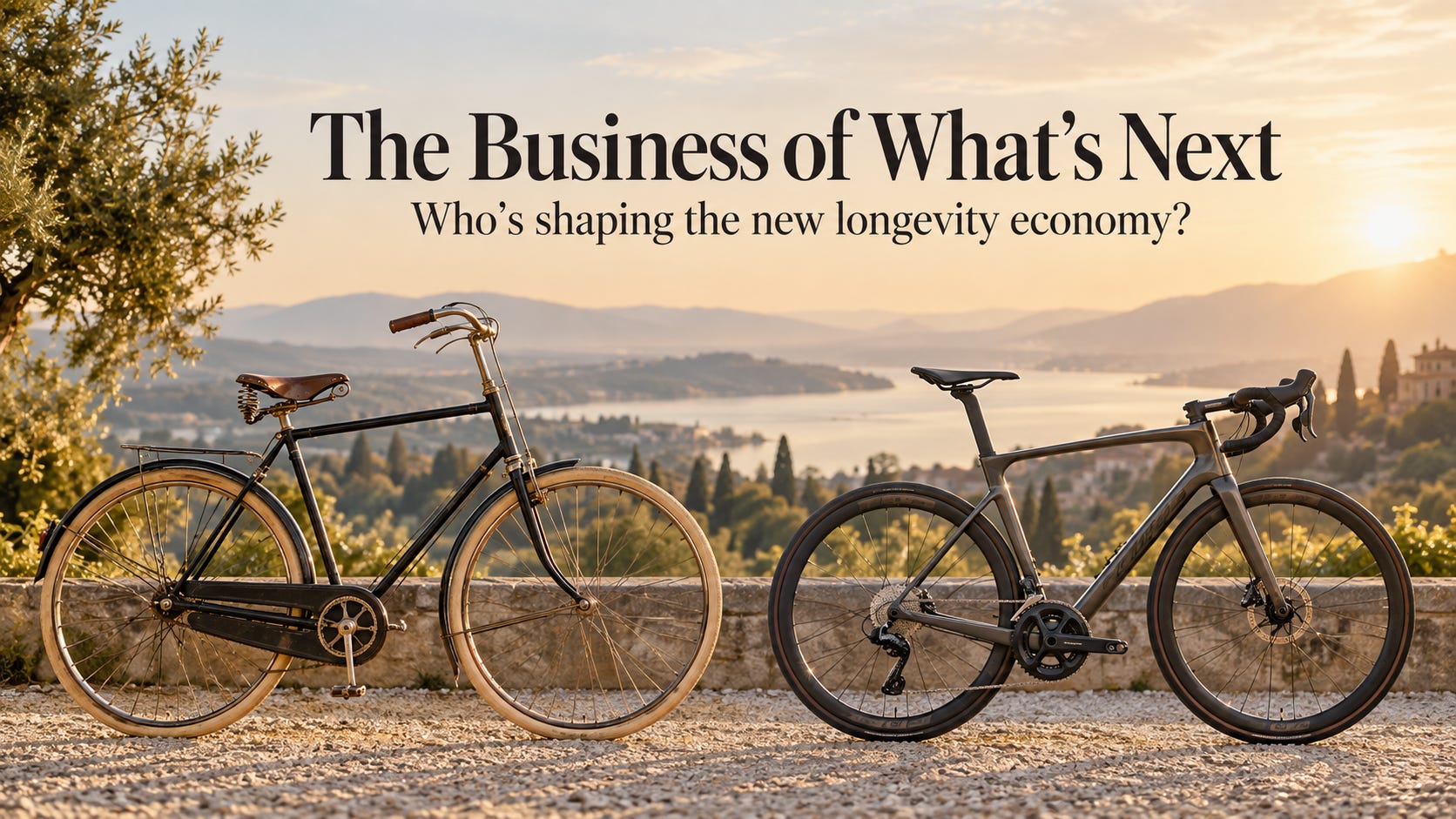
What bicycles can teach us about a new market
As I listened to my new acquaintance describe the growing number of initiatives, I thought about bicycles.
In the late nineteenth century, the bicycle represented possibility: mobility, independence, and a new way of experiencing the world. Entrepreneurs rushed in. Companies multiplied. People experimented with designs and business models.
Then the industry changed. According to the Smithsonian, the number of bicycle manufacturers in the United States fell from 312 in 1900 to 101 in 1905. Some early automobile builders had started out making bicycles. The opportunity did not disappear, but the companies and industries built around it evolved.
The automobile industry followed its own path of invention, competition, and consolidation. Many names that once seemed full of promise eventually disappeared.
I find myself wondering whether the emerging marketplace around longevity, purpose, and reinvention will experience something similar.
Today, there is an abundance of ideas: retreats, coaching programs, learning communities, women’s networks, intergenerational initiatives, and new models of work and housing. Some will flourish. Some will merge or change direction. Others may discover that enthusiasm for an idea does not necessarily translate into a sustainable organization.
That is not a prediction that the field will follow the bicycle industry’s exact path. A community or a learning experience is different from a manufactured product. But the historical pattern offers a useful question: Which organizations will create lasting value once the novelty of the market wears off?
A question of access—and of value
There is another question we should ask as this market grows: Who gets to participate?
Some experiences require substantial time and money. MEA, for example, says its three-day workshops typically start around $2,400, with room, meals, and sessions included; some workshops offer partial, need-aware scholarships. Lustre lists an annual membership at $125. These are different offerings with different costs, but together they illustrate the range of business models emerging in this space.
For one person, a retreat may be a meaningful investment. For another, even a modest membership fee may be out of reach. And many people approaching later life are navigating caregiving responsibilities, financial uncertainty, health concerns, or the need to keep earning.
If the conversation about purpose and belonging is to reach beyond a relatively privileged audience, we will need accessible local communities, public institutions, employers, libraries, nonprofits, and intergenerational relationships to be part of the story, too.
We should also resist the idea that everyone must reinvent themselves in the same way. A person might want to start a business, mentor younger colleagues, care for family, make art, volunteer, find friendship, or simply have more time to enjoy life. Some may not identify with the word “retirement” at all.
There is no single customer called “the older adult.” There are people with different histories, resources, ambitions, and needs.
The anthropologist’s question
As a corporate anthropologist, I am fascinated by the stories a culture tells about who matters.
For a long time, the American story of retirement seemed to suggest that after a certain age, we step aside. We stop contributing in the ways that count. We become consumers of leisure—or recipients of care—rather than creators of what comes next.
The people and organizations in this emerging field are challenging that story. That is worth paying attention to.
But I hope we will ask more than whether a program has found a compelling message or a profitable niche. Does it help people form lasting relationships? Does it open doors to meaningful work or contribution? Does it listen to people whose experiences differ from its founders’? Does it make room for uncertainty, grief, and financial reality alongside optimism?
And perhaps most of all: Does it help people see possibilities they could not see before?
The woman I met had clearly found something meaningful in her experience. Her enthusiasm prompted me to look more closely at a much larger movement.
We are living through a moment when the meaning of aging is being renegotiated—and when entrepreneurs, institutions, and communities are helping shape the alternatives. Some of their ideas may last; others may be early experiments.
The need beneath them, however, is likely to endure: the desire to belong, to contribute, and to feel that our lives still have room for discovery.
What do you think? Have you encountered a community or program that helped you imagine your next chapter? And what do you think is still missing?
all you need to do is close your eyes and think of where you'd like to be and what you'd like to be doing. the hardest part is sometimes making that happen.
Insightful note. I am living through it now, but I haven't found any useful programs so far.