

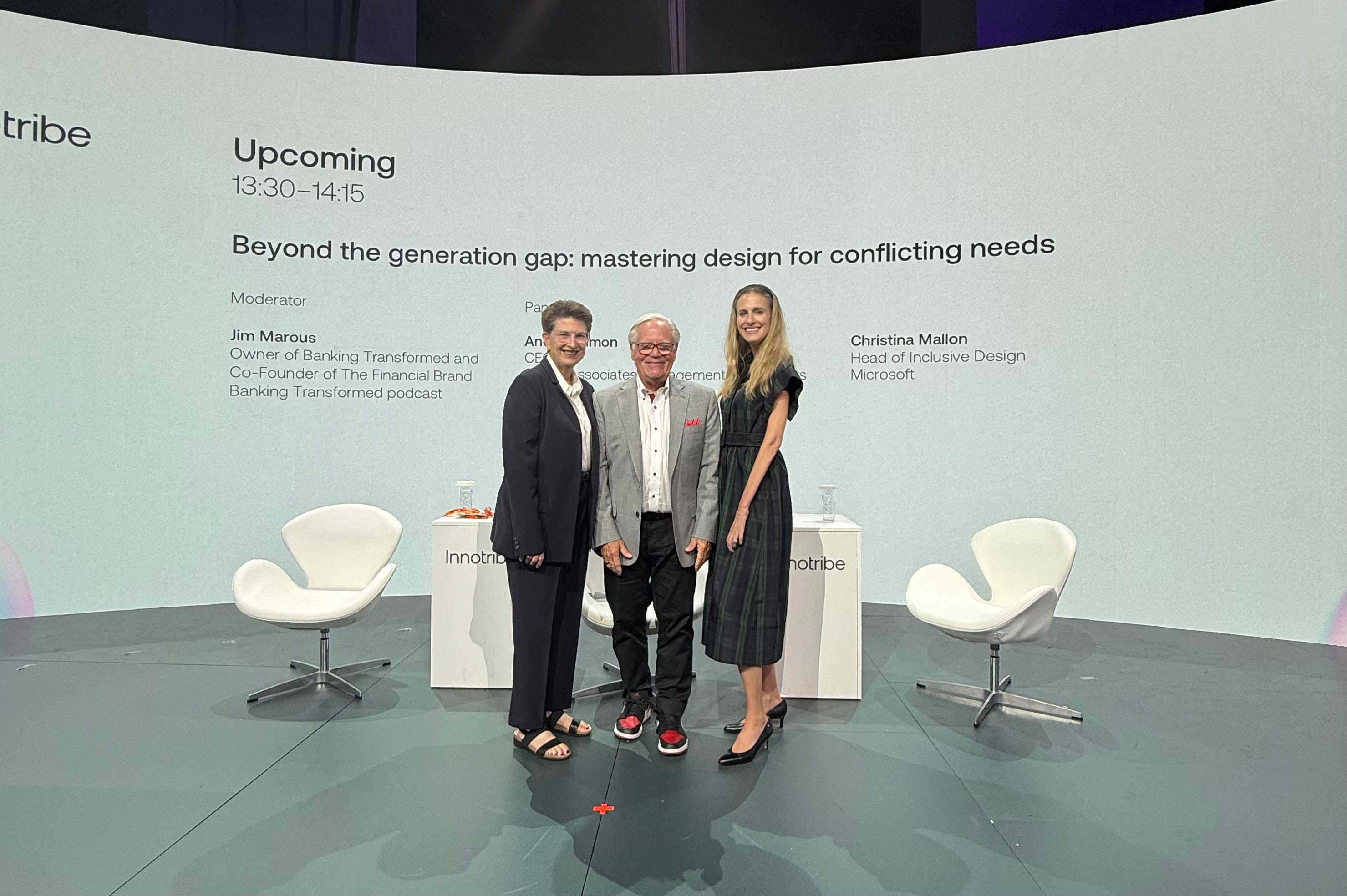
Yesterday I spoke at Sibos, the enormous global gathering of leaders in financial services—from banks and payments companies to the people building the infrastructure for the next generation of AI and agentic financial services. The theme was: "Digital finance for AI-driven economies."
I loved being there.
With new AI capabilities such as Muse arriving almost as we gathered, there was a wonderful sense throughout the conference that we don’t know what we don’t know.
That is exactly the kind of moment when an anthropologist becomes very useful.
My fireside chat focused on a deceptively simple question:
Who exactly are we designing all this new financial technology for?
My co-speaker was Christina Mallon, who leads Inclusive Design at Microsoft and serves on the boards of Inclusively and Open Style Lab. Our moderator, Jim Marcus, kept bringing us back to the human side of this extraordinary technological transformation.
And that is where I think financial services has some serious rethinking to do.
A birth year isn’t a behavior
For years, marketers and financial institutions have divided us into generations.
Boomers. Gen X. Millennials. Gen Z.
The categories are convenient. But increasingly, they aren’t particularly useful for understanding how people actually behave.
I am supposedly a Boomer. What exactly does that tell you about how I use technology? How I manage my money? Whether I want to work? What I am planning for the next decade of my life? How comfortable I am with AI?
Not very much.
Yet assumptions about older adults are everywhere. Sometimes they come from surveys. Sometimes from demographic data. And sometimes, I suspect, they come from someone’s image of their grandparents.
The people I have been studying don’t behave according to those stereotypes.
Through our research in senior living communities, interviews with people approaching and navigating retirement, and workshops with people redesigning the next chapters of their lives, we keep discovering enormous variation.
Some people want simplicity. Others want control.
Some want an advisor they can sit across from. Others want to manage everything from their phones.
Some are cautious about AI. Others are already experimenting with it.
And the same person may want different things at different moments.
That is the problem with designing around demographic categories. People don’t live in categories. They live in circumstances.
The wealth transfer isn’t something happening tomorrow
One of our conversations at Sibos focused on the enormous transfer of wealth expected from older generations to their children and grandchildren.
It is often discussed as though it were some future event.
But from our research, I see something different.
The transfer is already happening.
Younger people are inheriting homes. Parents are helping children purchase houses. Families are transferring assets while parents are still alive. Adult children are becoming involved in their parents’ financial affairs. Real estate that once represented a family home suddenly becomes an investment, an inheritance, a tax question, or a difficult family decision.
These aren’t simply financial transactions.
They are human experiences filled with emotions, relationships, expectations, uncertainty, and often very little preparation.
That changes the opportunity for financial services.
Instead of asking, “How do we capture the next generation when they inherit their parents’ money?” perhaps the better question is:
What is happening in their lives right now, and how can we help them navigate it?
Become an anthropologist
That was my closing challenge to the audience at Sibos.
Go become anthropologists.
Not literally. You don’t need another degree.
But you do need to get out of the conference room.
Go hang out with your customers.
Sit with a CFO and watch how they actually manage their company’s funds.
Spend time with a 70-year-old entrepreneur who has absolutely no intention of retiring.
Talk with a 40-year-old who suddenly owns a parent’s house and has no idea what to do with it.
Watch how people use your apps. Listen to what frustrates them. Notice what they do instead of what they tell you they do.
Don’t imagine your customers. Don’t project onto them what you believe they do—or what you think they should do.
Go see them.
Because we are about to build an entirely new generation of financial services around AI, autonomous agents, embedded finance, and technologies we are only beginning to understand.
The technology may be extraordinary.
But if we don’t understand the humans using it, we may be solving the wrong problems extraordinarily well.
And that may be the biggest opportunity of all.
See. Feel. Think. Then design.
Want to bring this conversation to your organization? I speak with leadership teams and conference audiences about seeing change through the eyes of the people living it—and using an anthropologist’s perspective to rethink customers, culture and transformation. If this is a conversation your organization needs to be having, I’d love to hear from you.
The adult children point is where a lot of banks still struggle. Getting added to a parent's account or having a power of attorney accepted can take branch visits and weeks of back and forth, right when the family needs it to be simple.
The old definition of knowing involved having experienced. Statistically evolved models can’t do that. I love your advice. I hope it gets followed.